
The value of Indonesia's online food delivery transactions reached US$6.4 billion, or approximately IDR 100 trillion, in 2025, representing an 18% increase from the previous year. According to estimates by Momentum Works, this growth highlights the increasingly important role of digital channels in Indonesia's food and beverage (F&B) industry.
At the same time, customers continue to make purchases directly at restaurants, cafés, and food outlets. This means F&B businesses must now manage transactions across multiple sales channels simultaneously. Omnichannel POS software for F&B businesses is one of the technologies that helps integrate these activities, ranging from sales recording to operational monitoring within a unified system.
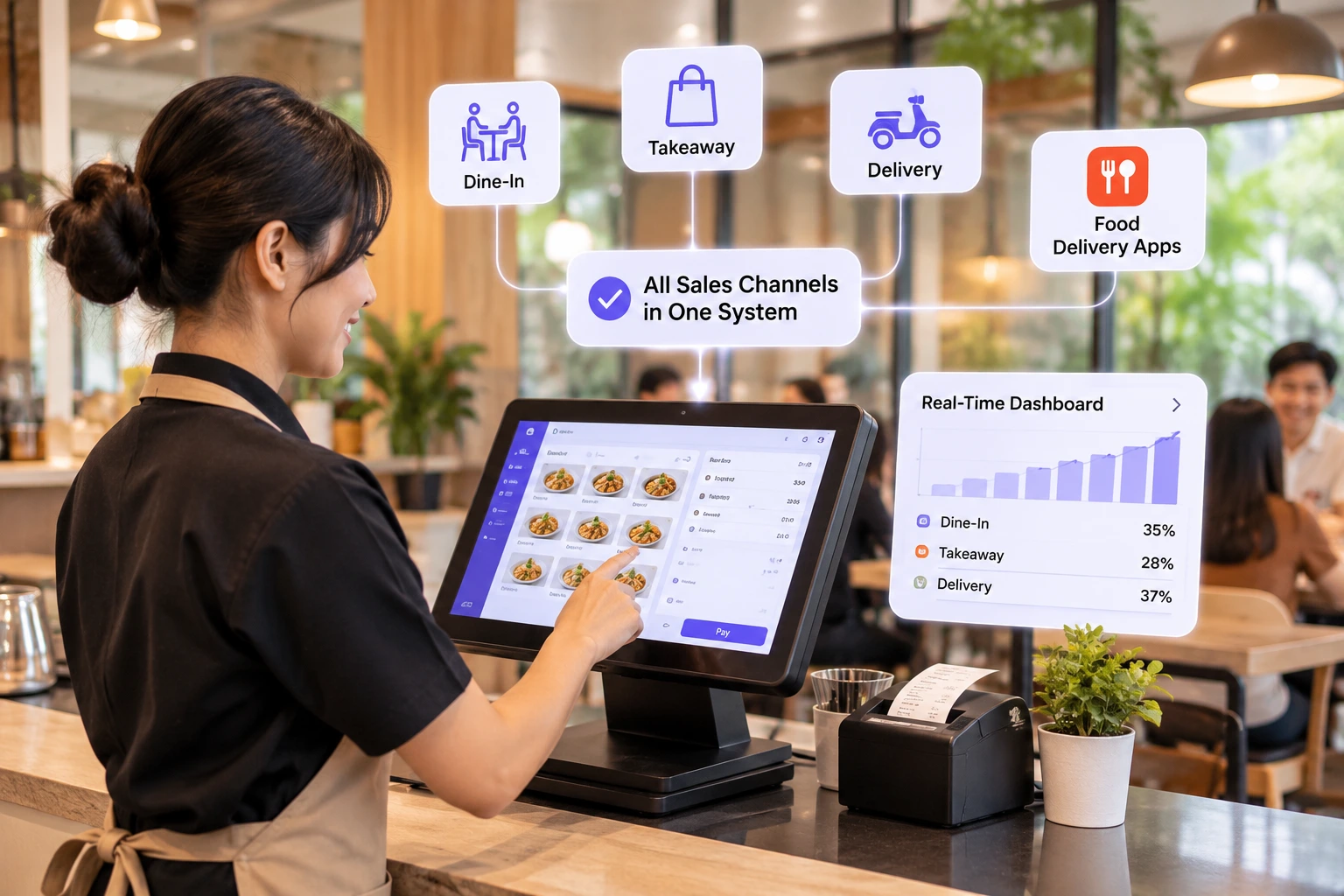
Omnichannel is a business approach that connects multiple sales channels to deliver a consistent customer experience, whether customers make purchases in person or through digital platforms. In the F&B industry, these channels may include dine-in, takeaway, websites, ordering applications, and food delivery services.
This shift is also reflected in changing consumer behaviour. A Snapcart survey conducted in January 2025 among 4,857 respondents in Indonesia found that 73% had used online food delivery services. Promotions and discounts were among the primary reasons behind their use of these platforms.
This development means restaurants can no longer rely solely on conventional cash register systems. When orders come from multiple channels, businesses need a system capable of consolidating transaction, menu, and sales data to maintain well-organised operations.
Omnichannel POS software for F&B businesses enables them to manage transactions from multiple sales channels without having to record each one separately. This technology allows sales information to be consolidated in one place, giving business owners a more comprehensive overview of their operational performance.
For example, consider a restaurant that offers dine-in, takeaway, and online delivery services. Without an integrated system, staff may need to check orders across different devices, record transactions manually, and combine sales reports at the end of each day.
These processes can increase the risk of data entry errors, delayed inventory updates, and discrepancies in sales figures. With omnichannel POS software, transaction records can be centralised, depending on the integration capabilities of the system being used.
Several benefits make this technology increasingly relevant to F&B businesses:
Not all POS applications offer the same omnichannel capabilities. Therefore, restaurant owners should evaluate the features that genuinely support their operational requirements.
One important consideration is a cloud-based POS system, which allows business owners to access sales data more flexibly. Multi-outlet management is also essential for restaurant businesses with multiple branches, as it enables them to monitor the performance of individual locations through a centralized management system.
In addition, digital payment integrations such as QRIS can simplify the payment process. Meanwhile, a Kitchen Display System (KDS) helps relay order information directly to the kitchen, allowing staff to prepare meals based on the incoming order queue.
Other equally important features include automated sales reporting, menu management, promotional settings, and customer relationship management (CRM) integration. Together, these capabilities help businesses connect transaction activities with customer management and sales performance evaluation.
As businesses expand across more sales channels, maintaining consistent information becomes increasingly challenging. Imagine a restaurant updating its menu prices in the main POS system but failing to apply the same changes to its online ordering platforms. As a result, customers may still see outdated prices when placing orders online.
Situations like this can create confusion for both customers and operational staff. Similar issues may arise with product availability, promotional offers, and order records.
For this reason, implementing omnichannel POS software requires careful consideration of data synchronisation capabilities, compatibility with existing platforms, and the operational requirements of each outlet. Business owners should also determine whether integrations are available directly, through third-party partners, or require additional configuration.
At this stage, OMNI POS can be considered as one of the solutions for supporting F&B business management. With features such as multi-outlet management, payment integration, transaction management, and sales reporting, OMNI helps businesses establish more structured operations within a unified system.
Before adopting omnichannel POS software, business owners should evaluate several factors to ensure that their chosen technology aligns with their operational needs.
The growth of food delivery services and evolving consumer behaviour have made multi-channel sales management increasingly important for F&B businesses. Omnichannel POS software helps restaurants connect transaction activities, reduce fragmented record-keeping, and gain a more comprehensive understanding of their overall business performance.
However, choosing the right technology is not simply about having access to a wide range of features. What matters most is how effectively the system supports day-to-day operational requirements and long-term business growth.
If your F&B business is looking to manage transactions and operations through a more integrated system, explore OMNI's POS solutions at getomni.id and discover the features that best suit your business needs.

 EN
 ID