
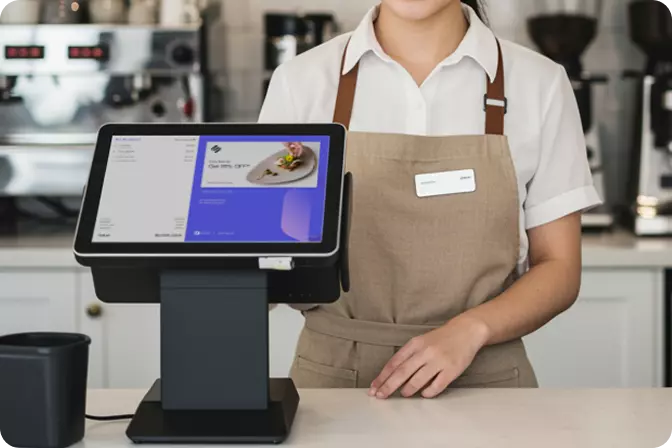


Many businesses in Indonesia start in a simple way: manual notes, calculators, and memory.
As long as transactions are still few, everything feels under control.
However, as the business grows, problems begin to appear:
These issues are not just about “operational neatness,” but relate to the business’s ability to grow.
At this point, businesses no longer need just a basic cashier tool, but the best POS application that can function as an integrated operational system.
The best POS application is not just about design or price.
More than that, a good system should be able to:
In other words, a modern POS application is the operational control center of a business.
Digital transformation in Indonesia is accelerating.
Relevant facts:
However, most businesses have not yet adopted POS systems optimally. This means the opportunity to improve efficiency and profitability is still very large.
Many businesses choose a POS application based on:
However, choosing the wrong system can have long-term impacts:
The best POS application is not the most popular one, but the one that best fits your business needs.
When used properly, changes are usually seen in the following areas:
All processes are recorded systematically.
No longer based on intuition.
No more “missing” stock or overstocking.
No need for manual recaps.
Not all features matter. Focus on those that deliver real impact.
The best POS application is not just about efficiency, but insight.
Examples of impactful insights:
Without a system, these insights often remain unseen.
|
Aspect |
Manual |
POS |
|
Speed |
Slow |
Fast |
|
Accuracy |
Low |
High |
|
Reports |
Manual |
Automated |
|
Insight |
Limited |
Data-driven |
Cloud-based systems allow business data to be stored online and accessed anytime without relying on a single device. This provides flexibility for business owners to monitor operations, review reports, and control transactions even when they are not physically present at the store.
Digital payment integration such as QRIS and e-wallets has become a standard in modern business operations. As consumer preference for cashless transactions continues to rise, POS applications that support multiple payment methods help businesses deliver faster, more convenient, and seamless experiences.
Businesses today no longer operate solely offline, but are connected to various online channels such as marketplaces and social commerce. POS systems that support omnichannel enable real-time synchronization of sales and inventory data, making operations more efficient and integrated.
Many businesses are shifting toward platforms that combine multiple functions into a single system, such as POS, inventory management, and reporting. This approach reduces operational complexity by eliminating the need for multiple separate tools while making overall business management more streamlined.
The approach to choosing a POS application is starting to shift.
Instead of looking for a system that only fits one type of business, many business owners are now considering solutions that are flexible and adaptable across different operational models.
In practice:
This means the ideal POS application is one that is flexible enough to adapt to business needs, both in the early stages and as it grows.
In today’s increasingly competitive business landscape, speed and accuracy are no longer advantages, they are necessities.
Managing a business without an integrated POS system can limit visibility and growth potential.
This is where OMNI POS comes in as a solution for modern businesses in Indonesia.
With features designed to support daily operations, OMNI POS helps you
It’s time to switch to a more practical way of managing your daily business operations with OMNI POS!