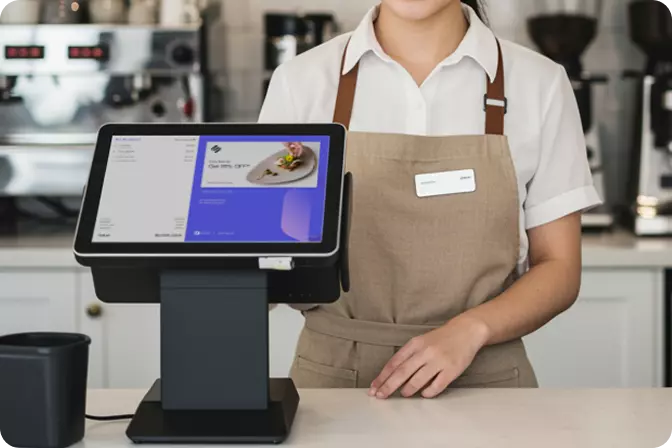

Around 85.55 per cent of culinary businesses in Indonesia already have an online sales channel, yet those channels contribute only 23.70 per cent of total sales. In other words, more than three quarters of the money still comes in over the counter at the outlet itself. This is the part that tends to get flipped around in an owner's head. Digitalisation gets treated as something that belongs to delivery apps, when the point that actually decides things is the POS system a cashier handles every single day. A proper cloud POS system is not a tool for recording sales. It is the source of daily operational data behind decisions about stock, menu, and how many people to put on a shift.
This myth shows up most often with owners who have just opened their first outlet. In reality, food and beverage is the largest category of micro and small enterprise in Indonesia, with roughly 1.94 million business units according to Statistics Indonesia. The digital infrastructure reached small outlets and cafes a long time ago. Bank Indonesia records QRIS as reaching 44.86 million merchants, and 96.68 per cent of them are MSMEs.
What most small outlets are missing is not the digital payment. It is the record-keeping layer sitting behind it. An outlet with 40 transactions a day produces around 1,200 rows of sales data a month. That is already more than enough to show which menu items genuinely carry the revenue and which ones are only popular in the owner's imagination.
Do the rough maths. An outlet turning over Rp150 million a month only needs to lose 2 per cent of its ingredient value to inconsistent portions, unrecorded voids, or staff discounts with no trail, and Rp3 million has already evaporated that month. A cloud POS subscription for a single outlet usually sits well below that figure.
Manual record keeping feels free because the cost never arrives as an invoice. It arrives as a month-end stock variance that nobody can explain.
Plenty of owners wait until they have three or four branches before caring about sales reports. The most expensive decisions are actually made at the first outlet, from menu composition to pricing to how many people work each shift. A decent POS system shows sales per item per hour, and that is usually where it turns out the owner's signature dish is not the one customers order most often.
Multi-outlet integration only starts to prove its worth once the second branch opens. The habit of reading the data has to form well before that.
First, cashless payment is the default now, not an extra. QRIS users have passed 65.77 million according to Bank Indonesia, and customers simply assume every outlet can accept it.
Second, POS systems have moved to the cloud. Owners can check outlet sales from a phone without going to the location, and the data is no longer locked inside one cashier computer that takes everything with it when it breaks.
Third, self-ordering kiosks are starting to reach mid-sized outlets, especially the ones where queues build up at lunchtime. For a small restaurant this is not urgent yet. For anyone already running two or three busy branches, it is worth taking seriously.
OMNI Point of Sale is built for exactly this situation, a cloud POS system that brings transactions, stock, and sales reports together in one place, with multi-outlet integration ready for the moment the business widens. Because it sits inside the Stamps ecosystem, transaction data can connect to loyalty programmes, so regular customers get recognised without any extra record keeping. The module details are on the OMNI Point of Sale page.

 EN
EN
 ID
ID