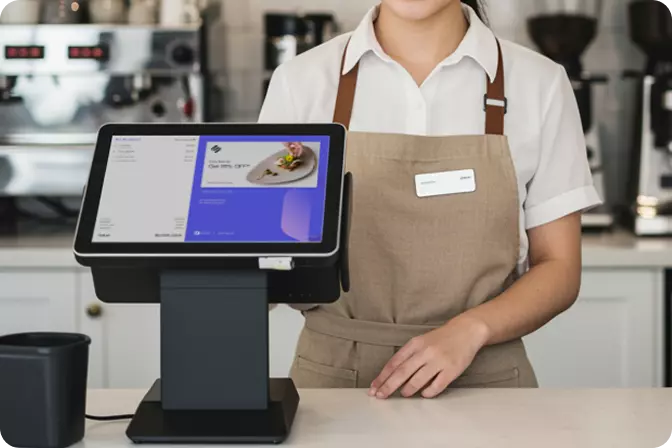


In most F&B outlets, the two cashier lines that get mixed up the most are "would you like to upsize that?" and "anything to drink with it?". They sound similar, but they do different jobs. Upselling invites the customer to move up a tier on the item they have already chosen, such as going from a regular to a large. Cross-selling offers a separate item that complements that choice, such as a drink or a side of fries. One moves upward, the other moves sideways, and that is the most practical way for a business owner to think about the difference between upselling and cross-selling.
Upselling happens when the product stays the same and only the version changes. A regular coffee becomes a large. A single portion becomes a full combo. The added value looks small on paper, typically Rp5,000 to Rp10,000 per transaction in casual dining, yet it adds almost nothing to operating cost because the customer is already standing at the counter. You are not paying for advertising a second time to bring that person in.
Cross-selling works sideways. The customer has already picked a burger, and is then offered a drink or an extra sauce that was never part of the original decision. A widely cited McKinsey figure puts roughly 35 percent of Amazon's sales down to its product recommendation engine, which is the best known form of cross-selling in the digital world. In a physical outlet the principle is identical, and only the medium changes, from an algorithm to a cashier or an ordering screen.
Applied consistently, both techniques lift daily revenue far more than most owners expect. You can run the numbers against your own outlet data. The assumptions here are five outlets, an average of 400 transactions per outlet per day (2,000 transactions in total), and Rp8,000 in added value each time an offer is accepted.
|
Condition |
Offer acceptance rate |
Added revenue per day |
Added revenue per month |
|
Offers depend on the cashier remembering |
5 percent |
Rp800,000 |
Rp24 million |
|
Offers appear on every transaction |
15 percent |
Rp2.4 million |
Rp72 million |
The gap is Rp48 million a month across five outlets, with no price increase, no new menu items, and no additional customers. The only variable that changes is how consistently the offer is made. This is also why upselling and cross-selling belong in a different category from discount campaigns, since the customer acquisition cost attached to them is effectively zero.
Three causes account for most of the loss in multi-outlet operations.
Queue pressure. During peak hours, cashiers optimise for speed. The add-on offer is the first thing dropped, and peak hours are precisely when your transaction volume is highest.
High staff turnover. Every new cashier has to be retrained on the script. Execution varies from person to person, and quality is lowest during exactly the weeks when they are still learning the menu.
Weak central visibility. Head office has no record of who offered what and how often it was accepted. Without that data, nothing can be corrected, because the problem never becomes visible.
The effect compounds. The more branches you add, the wider the execution gap grows between your strongest and weakest outlet, and your company-wide average ticket value gets dragged down with it.
A self-ordering kiosk breaks that chain at the cause rather than the symptom. Upsize options and complementary items appear automatically on every order, in a sequence configured centrally, so the offer rate stays at 100 percent regardless of queue length or how long a staff member has been on the job. Because OMNI Kiosk runs on the same cloud POS system, you can see which offers are accepted and which are ignored at each outlet, then change them once and push that change to every branch.
If your average ticket value has been flat while transaction volume holds steady, the problem is usually not the product. It is an offer that never reliably reaches the customer. Understanding the difference between upselling and cross-selling is the first step, but execution still needs a system that does not get tired when the queue builds up.
Install OMNI Kiosk in your busiest outlet, let it run for a month, then compare its average transaction value against your other branches. Numbers tend to be more persuasive than theory.

 EN
EN
 ID
ID