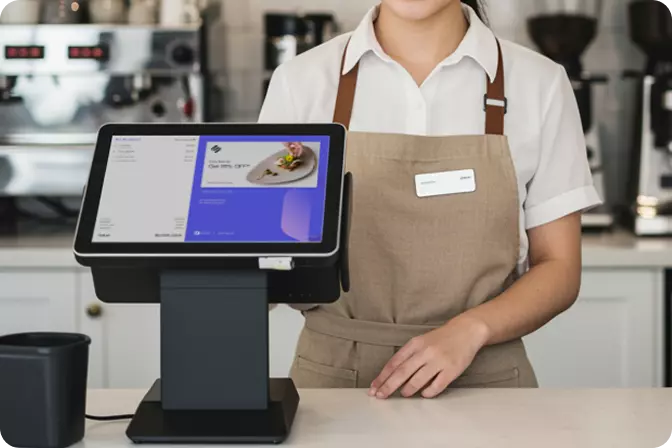

Business growth in Indonesia has made daily operations increasingly complex. Many businesses today no longer serve customers only through physical stores, but also through marketplaces, social commerce, and rapidly growing digital payment systems. At the same time, business owners still need to ensure inventory remains controlled, reports are easy to monitor, and operations run efficiently every day.

The challenge is that many businesses still rely on manual processes or disconnected systems to manage all these needs. As a result, data becomes unsynchronized, operational monitoring becomes more difficult, and business processes become less efficient. In situations like this, businesses no longer simply need cashier tools, but modern POS applications capable of supporting more integrated operations. This is where the OMNI POS application becomes relevant as a solution designed to help businesses manage operations more practically and flexibly.
OMNI POS application is one of modern POS applications that helps businesses manage transactions, inventory, payments, and operational monitoring within one system.
This approach helps businesses:
Because of this, modern POS applications no longer function only as transaction tools, but also as operational control centers for businesses.
As businesses grow, operations become increasingly difficult to manage manually.
Many businesses begin facing:
When all these processes are managed separately, the risk of operational errors becomes much higher. This is why many businesses are adopting POS applications that help simplify daily operations.
When systems are used effectively, improvements are usually seen in the following areas:
1. Simpler operational processes, many manual tasks are reduced because the system automates recording processes.
2. More practical business monitoring, sales and operational data can be monitored more quickly.
3. Better inventory control, inventory changes are automatically recorded during transactions.
4. Faster decision-making, business reports become easier to use for evaluation and strategy.
Many businesses have already grown, but their operational systems have not evolved at the same pace.
As a result:
Over time, these conditions can slow operations and reduce business efficiency. This is why more integrated systems are becoming increasingly important for modern businesses.
In the past, POS applications were only used to record sales. Today, modern POS systems also help businesses:
This evolution is what makes POS applications an essential part of modern business operations.
1. Real-time reporting, helps businesses monitor operations faster and more accurately.
2. Inventory tracking, simplifies daily inventory management.
3. Digital payment support, supports multiple digital payment methods.
4. Multi-outlet management, helps businesses monitor multiple branches within one system.
5. Centralized operational systems, all business data can be managed more centrally.
|
Aspect |
Standard POS Application |
OMNI POS |
|
Main focus |
Cashier transactions |
Integrated business operations |
|
Business monitoring |
Basic reporting |
Real-time dashboard |
|
Payment integration |
Limited |
Supports multiple payment methods |
|
Inventory management |
Basic stock tracking |
More structured inventory control |
|
Multi-outlet support |
Not always available |
Centralized monitoring |
|
Omnichannel support |
Limited |
Supports online & offline operations |
|
Scalability |
Suitable for simple operations |
More flexible for growing businesses |
|
Business visibility |
Limited to transaction reports |
Broader operational insights |
As businesses continue to expand, having systems that support more efficient and integrated operations becomes increasingly important.
At this stage, many businesses begin looking for solutions that help:
As one of Indonesia’s modern POS solutions, OMNI POS application offers a more flexible and integrated operational approach for various types of businesses. With systems designed for modern operational needs, businesses can manage daily activities more practically, systematically, and with easier visibility within one platform.
It’s time to manage business operations more efficiently with OMNI POS!

 EN
EN
 ID
ID