
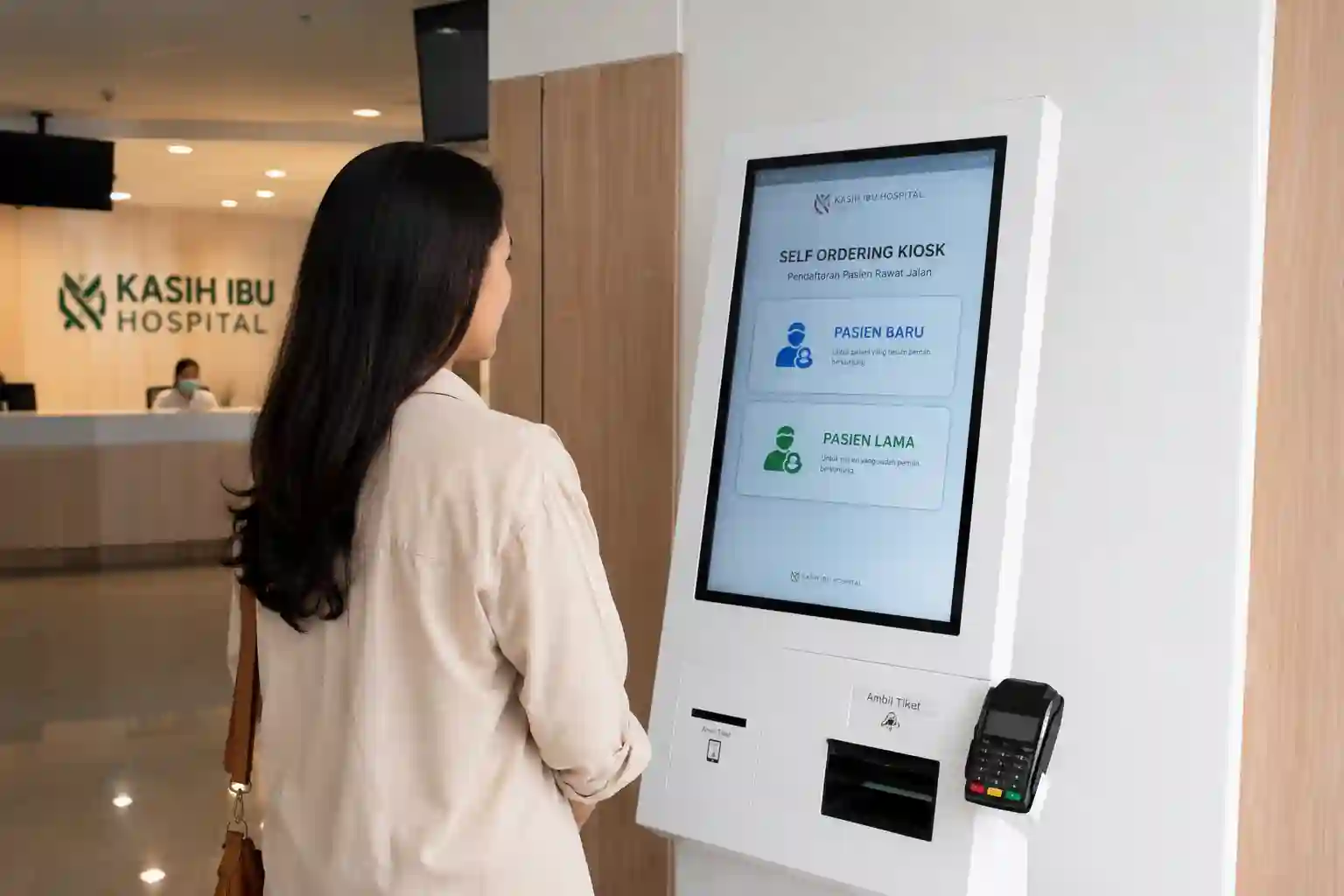
A hospital kiosk is a touchscreen-based self-service device that allows patients to register, print queue numbers, and even make payments without waiting in line at a counter. In Indonesia, this device is also known as the Self-Service Registration Station (Anjungan Pendaftaran Mandiri, or APM), and it has been proven to reduce registration time from one to two hours down to a matter of minutes. This article examines how these kiosks work, their various types, their benefits, examples of their implementation in Indonesian hospitals, and tips for selecting the right one for your healthcare facility.
A hospital kiosk is a touchscreen-based self-service terminal that enables patients to register, check in for appointments, print queue numbers, and make payments without assistance from counter staff. In Indonesia, the device is more commonly known as the Self-Service Registration Station (APM) a machine that resembles an ATM at first glance, but whose function is to handle patient administration rather than cash transactions.
For hospital directors and management, the simplest way to understand it is this: a kiosk is an additional counter that works tirelessly, never takes leave, and serves patients with a consistent workflow from morning until night.
The process is designed to be as simple as possible, even for first-time users:
The patient proceeds to the kiosk rather than the counter. They simply scan an identity card, a BPJS card, or enter a medical record number. The system verifies the data automatically. The kiosk is connected to the Hospital Management Information System (SIMRS), so existing patient records are recognised instantly.
The patient selects the intended polyclinic, doctor, or follow-up schedule, then prints a queue number along with the required documents, including the Patient Eligibility Letter (SEP) for BPJS members.
The data flows to every unit. Polyclinics and medical records departments are immediately notified of the patient's arrival and can prepare to deliver their services. What is particularly valuable for management is that every interaction at the kiosk is recorded as data. Peak-hour patterns, the busiest polyclinics, and service durations can all be processed into material for decision-making.
Hospital kiosks come with several functions that can operate independently or be combined within a single device:
Self-service registration kiosks (APM). The most common type in Indonesia, these handle outpatient registration for existing patients, whether general or BPJS members.
Check-in and queue kiosks. Designed for patients who have already registered online (for example, via the Mobile JKN application) and simply need to print their queue number on the day of their visit.
Information and directory kiosks. These help patients and their families locate polyclinics, view doctors' schedules, or access service information.
Payment kiosks. These process outpatient bill payments independently via QRIS, debit card, or e-wallet.
Satisfaction survey kiosks. These collect patient feedback in real time as material for evaluating service quality.
When evaluating a kiosk for your hospital, view it through the lens of its impact on service rather than its technical specifications:
Full integration with SIMRS, so that patient data is synchronised in real time without staff having to re-enter it.
Connection to the BPJS Kesehatan system and Mobile JKN, including SEP printing an absolute necessity given the large proportion of JKN patients in Indonesia.
An interface that is friendly to all ages. Large buttons, a short workflow, and simple language determine whether elderly patients will be willing to use it.
An integrated document scanner and printer for identity cards, treatment cards, and queue numbers.
An analytics dashboard for management, covering everything from visit volumes per polyclinic to peak service hours.
Hospital branding, so that the kiosk appears as part of the service identity rather than an unfamiliar machine in the corner of the lobby.
The evidence from the field speaks loudly enough. The implementation of the APM at Arifin Achmad Regional Hospital in Riau Province, for instance, was targeted at reducing registration queues that typically take one to two hours down to around five minutes. Meanwhile, research at Surakarta Central General Hospital, published in 2025, found that 70.5 per cent of respondents considered the APM easy to use, and that its adoption had a significant effect on service effectiveness encompassing productivity, efficiency, and patient satisfaction.
From a management perspective, the benefits can be summarised in four points:
Waiting times shrink dramatically. Registration that once took hours is now completed in minutes, and patient satisfaction is a quality indicator assessed during accreditation.
The workload of counter staff is reduced. Administrative staff can be reassigned to roles that require human empathy: serving elderly patients, handling complex cases, or addressing complaints.
Data accuracy improves. Patients enter and verify their own data, reducing recording errors including with respect to privacy, since some patients feel more comfortable entering their personal details themselves.
A modern hospital image. Amid competition in healthcare services, a seamless registration experience becomes a memorable first impression.
Map out your needs first. Is the main problem registration queues, payments, or information? The answer to this determines which type of kiosk to purchase.
Ensure compatibility with SIMRS and BPJS before signing any contract real-time data synchronisation is non-negotiable. Test it with real patients, particularly the elderly. Field research shows that age and network connectivity issues are the greatest barriers to APM adoption.
Prepare staff to assist during the transition period. No matter how sophisticated the machine, it still requires user education in the early months. Calculate the total cost of ownership: the device, licensing, maintenance, and network connectivity not merely the purchase price.
Hospital kiosks have evolved from a lobby accessory into a strategic instrument: cutting registration time from hours to minutes, easing the burden on staff, improving data accuracy, and strengthening the image of modern service. Evidence from hospitals in Sukoharjo, Riau, and Mojokerto demonstrates that this technology works within the Indonesian context complete with the BPJS and Mobile JKN integration that addresses the local market's distinctive needs.
For directors and management, the wise course of action is clear: start with the most critical queue point, ensure full integration with SIMRS and BPJS, support patients during the transition, and then measure the impact on waiting times and satisfaction. The best kiosk is not the one with the largest screen, but the one that best understands your patients' journey.

 EN
EN
 ID
ID