

Seventy-three percent of small business owners in Indonesia only discover their store is operating at a loss once the monthly books are closed, rather than at the moment the loss actually occurs. This means that leakages, whether from discounts applied in error, miscalculated change, or stock that has quietly vanished, only come to light a full month later. Yet every one of these warning signs would already have surfaced in the daily sales report, had anyone actually taken the time to read it each day.
A daily sales report is far more than a simple record of turnover. It is a summary of a single day's operational transactions, encompassing total revenue, transaction volume, best-selling products, payment methods, and gross margin. Its function is straightforward yet critical: to give business owners a real-time picture of their venture's financial health, rather than a picture that is already thirty days out of date.
Many small business owners still regard monthly reporting as sufficient. In reality, the logic runs in the opposite direction. A monthly report is a cumulative outcome, whereas a daily report functions as an early-warning radar. When a problem is only detected through the monthly report, the losses involved have already compounded thirtyfold.
Consider a coffee shop with average daily revenue of three million rupiah. If a cash discrepancy of fifty thousand rupiah occurs each day due to human error at the till, that amounts to one and a half million rupiah lost over the course of a month, with no clear trail to explain it. With a daily report that is consistently reviewed, this discrepancy could instead be caught on day one, rather than surfacing at month's end once it has accumulated and become far harder to trace back to its source.
There are three reasons why the daily sales report is an indispensable instrument rather than an optional extra:
The majority of small businesses in Indonesia still compile their daily sales reports manually, whether through a cash ledger, a spreadsheet, or a WhatsApp recap sent in by cashiers. This approach is not inherently flawed, but it has clear limitations once transaction volume or the number of outlets begins to grow.
Manual reporting typically takes twenty to forty minutes to compile, is prone to human error when figures are re-entered from receipts, is difficult to monitor remotely, and produces data that is already outdated by the time it is compiled, since this only happens after the store has closed for the day.
Reports generated by a cloud-based POS system, by contrast, are recorded automatically with every transaction, available in real time via phone or laptop, and combine sales data with stock data simultaneously.
A multi-outlet scenario illustrates the gap starkly: with manual record-keeping, comparing the performance of five branches within a single day is virtually impossible to achieve with any accuracy. With multi-outlet integration built into a cloud-based POS system, however, data from every branch is automatically consolidated into a single dashboard, allowing cross-outlet comparisons to be made within seconds rather than days.
A good report is not defined by its length but by how actionable it is. The following elements should ideally always be included:
Business owners who focus solely on revenue figures without accounting for margin often fall into a mistaken assumption. The best-selling item is not necessarily the most profitable one, particularly when its ingredient costs are also high.
One of the largest sources of human error in daily sales reporting occurs at the point of input, namely when a cashier manually records an order or calculates change during a busy rush. Errors in entering the wrong item, mis-keying an amount, or forgetting to apply a discount all directly undermine the accuracy of the report by day's end.
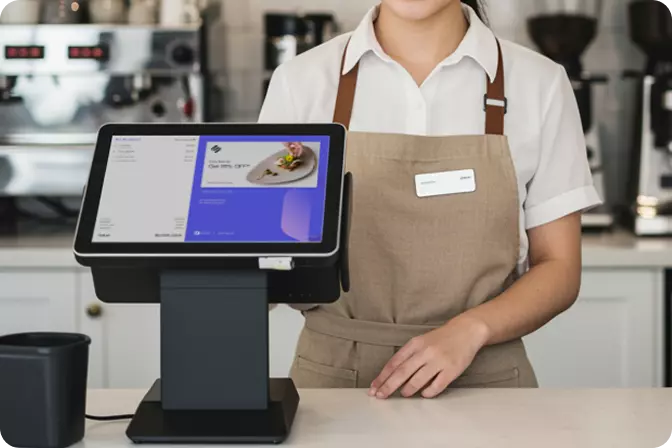
A cloud-based POS system with a simple, well-structured cashier interface narrows this margin for error, since every item already has a fixed price and category built into the system rather than being re-entered manually with each transaction. The result is a daily sales report that more precisely reflects actual transactions, rather than one shaped by a cashier's potential mishearing or miswriting amid a long queue.
If your business is still a single outlet with a low transaction volume, manual reporting may still be workable, albeit not without the risk of human error. But once you operate more than one outlet, once daily transaction volume exceeds fifty, or once you frequently find yourself thinking "why doesn't this report match the actual cash on hand", that is a clear sign your manual system has been outpaced by the complexity of your business.
OMNI offers a cloud-based POS system designed precisely for these needs, with real-time daily sales reporting and a multi-outlet dashboard on a single platform. If you are curious about what a truly reliable daily report looks like, one that spares you the nightly drama of manual reconciliation, schedule an OMNI POS demo and see for yourself how your business data can start working for you, rather than the other way around.

 EN
EN
 ID
ID