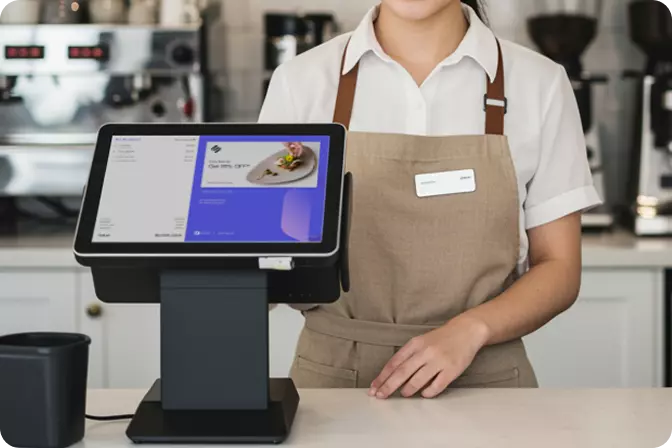

When a restaurant chain adopts a kiosk app, the reason most often given is almost always the same: to reduce queues at the counter during peak hours. That reasoning is not wrong, but this very perspective leads many businesses to overlook the technology's greatest value.

A kiosk app is not merely a tool for shortening queues; it is a sales channel and a source of customer data that directly affects business margins. The same self-ordering device that speeds up service also raises the average order value and records customer behaviour that has never been captured at the counter.
This article examines the impact that is rarely accounted for when deciding to adopt a kiosk, namely its influence on margins, data, and the quality of decision-making. If a kiosk is judged solely by service speed, the benefit you are measuring is most likely the smallest one.
Queues are a visible problem, so it is natural that they become the main reason for adopting a kiosk. The issue is that when a kiosk is judged solely by speed, the investment decision becomes shallow as well. If the only measure of success is a shorter queue, then once the queue is reduced, the kiosk is considered to have fulfilled its purpose, even though only a small part of its potential has been used.
This perspective also tends to place the adoption decision entirely in the hands of the operations team, separate from any revenue considerations. As a result, the kiosk is acquired for efficiency but is never optimised to sell. As will be explained, it is precisely this ability to sell that recovers the investment most quickly.
This is the impact most directly reflected in financial performance. Kiosks consistently raise the average order value, and the figures are far from negligible.
A range of industry data shows that self-ordering kiosks can lift the average order value by between 10 and 30 percent. McDonald's reported an increase of around 30 percent in order value after introducing kiosks, while a study by Hamburg Business School found that customers tend to spend 14 to 16 percent more when using self-ordering technology.
The reasons are both psychological and operational. Without a cashier present and free from the pressure of a queue, customers have greater freedom to explore the menu and add to their orders. At the same time, kiosks present add-ons and size upgrades consistently on every order, something that is often missed in manual service due to time constraints or staff conditions during busy periods. This consistency is what makes the kiosk a reliable sales instrument.
Every interaction at a kiosk leaves a valuable trace: menu items that were viewed but not ordered, the combinations most frequently chosen, the peak selling times for a given product, and the add-on offers that were accepted or declined. In conventional counter service, most of this information is lost without ever being recorded.
It is the value of this data that often goes unnoticed. By understanding ordering patterns by time and location, you can refine your menu composition, design more relevant bundles, and manage inventory more accurately. A kiosk turns every transaction into an actionable data point, rather than a sales record that simply passes by.
This benefit is frequently misunderstood as a reduction in headcount. In practice, most businesses retain their staff numbers but reassign their roles from taking orders to higher-value tasks, such as faster food preparation, quality control, and direct guest service.
The impact is not merely cost savings, but an increase in capacity. During peak hours, several customers can order simultaneously through kiosks, so more orders are processed in the same span of time without adding labour costs. A kiosk does not replace the human element of service; it redirects it to the area where it delivers the greatest value.
Not all kiosk apps deliver the same impact. The differentiator comes down to one fundamental factor: whether the kiosk is designed to drive sales or merely to record orders.
A kiosk that simply moves a printed menu onto a screen does cut queues, but its benefit stops there. A kiosk designed to sell, by contrast, makes use of appealing visual displays, presents add-on offers at the right moment, and highlights high-margin products that are currently available. The difference between the two is the difference between cost and revenue.
The decisive factor lies in integration. A kiosk connected directly to the POS system and inventory data can update the menu automatically, hide unavailable products, and steer customers toward the most profitable choices. Without that integration, a kiosk functions as nothing more than a digital version of a menu board.
Before investing, it is worth weighing the following five points so that the kiosk truly drives sales rather than simply moving the queue.
These five considerations determine the outcome of your investment far more than the number of kiosk units installed.
Kiosk adoption is not a passing trend. Between 2021 and 2023, the number of restaurant kiosks worldwide rose by around 43 percent, and it is projected to keep growing over the coming years. The global self-service kiosk market is also expected to grow steadily, at a double-digit rate each year.
The drivers are not only technological but also a shift in customer preferences. Most consumers, particularly younger ones, now find ordering via a kiosk more convenient and less stressful than ordering through staff. For F&B businesses in Indonesia, this signals that kiosks are gradually moving from a point of differentiation to a basic expectation, especially in the quick-service segment.
Are kiosks only suitable for large chains such as global fast-food restaurants? No. Mid-sized businesses stand to gain significantly, because kiosks raise both order value and capacity without adding labour costs. A smaller scale is not an obstacle, as long as the kiosk is integrated and designed to drive sales.
Does adopting a kiosk mean reducing staff? Not necessarily. Most businesses retain their staff numbers but reassign their roles from taking orders to higher-value tasks such as food preparation and guest service.
How long does a kiosk investment usually take to pay off? This depends on transaction volume and how well the kiosk is designed to sell. With a consistent rise in order value, many quick-service operators report recovering their investment within a matter of months.
What is the most common mistake in adopting a kiosk? Treating a kiosk merely as a digital version of a menu board. Without automated offers, an appealing display, and data integration, a kiosk only moves the queue without raising revenue.
What is the most important factor in a kiosk's success? Integration with the POS system and inventory data. This integration is what enables the kiosk to update the menu, promote high-margin products, and generate data that can be acted upon.
A kiosk app is not merely a queue-cutting device; it is a sales channel and a source of data that directly affects business margins. In organisations that use it well, the kiosk becomes a driver of growth. In organisations that judge it solely by speed, it functions as nothing more than a digital menu board.
This is where Omni comes in. As a platform trusted by leading F&B and retail brands in Indonesia, Omni connects your kiosk app with your POS system, inventory data, and loyalty programme within a single integrated ecosystem. In this way, the kiosk not only speeds up service but also raises order value and records customer data that can be acted upon immediately.
Your customers are already ready to order on their own. The question is whether your kiosk is ready to sell. Contact the Omni team to see firsthand how an integrated kiosk app can work for your business.

 EN
EN
 ID
ID